|
 
 Article © 2016 Macci and Kates
http://www.floridafamilylawyers.com/
| | |
Non-adversarial Family Law:
Collaborative
Law, Cooperative Law, and Mediation
Have you noticed that the Family Law Divisions of each county in Florida
are separate from the Civil Divisions? The reason is that the family law
courts are considered "courts of equity." Family courts are supposed
to deal fairly and equally with all concerned whether the issue concerns
a divorce, time-sharing, or child support.
However, all too often the battles that occur in family courts result
in decisions that seem to be, or actually are, unfair. This may be a result
of the differing lawyers' abilities, one party having a better court "disposition"
than the other, or the bias of a particular judge. It also may result from
decisions based on economics: one side simply can no longer afford to battle.
 The focus and basis of collaborative
family law (as well as collaborative law for resolving disputes in
other areas of the law), cooperative law, and mediation is to make resolving
disputes as non-adversarial as possible; to bring a sense of fairness and
control to the process. Non-adversarial family law seeks to reach an agreement
over the issues involved in a family law case without going to court, using
a negotiation process rather than an adversarial process whenever possible.
In both collaborative law and cooperative law cases the parties attempt
to reach agreement working with each other and with the advice and participation
of their respective lawyers. The parties and their attorneys also can utilize
an independent mediator if desired to help them achieve an agreement and
resolve their differences through mediation. What unites all three processes
is the desire to resolve all the family law issues by agreement, rather
than by the judge after a trial.
The focus and basis of collaborative
family law (as well as collaborative law for resolving disputes in
other areas of the law), cooperative law, and mediation is to make resolving
disputes as non-adversarial as possible; to bring a sense of fairness and
control to the process. Non-adversarial family law seeks to reach an agreement
over the issues involved in a family law case without going to court, using
a negotiation process rather than an adversarial process whenever possible.
In both collaborative law and cooperative law cases the parties attempt
to reach agreement working with each other and with the advice and participation
of their respective lawyers. The parties and their attorneys also can utilize
an independent mediator if desired to help them achieve an agreement and
resolve their differences through mediation. What unites all three processes
is the desire to resolve all the family law issues by agreement, rather
than by the judge after a trial.
In a collaborative law case the parties each retain their own independent
attorney. Each individual and their attorney decide if they want to try
resolving their issues using collaborative law. If so, the parties meet
with their respective attorneys to discuss whether they want to enter into
a collaborative law participation agreement. At the initial meeting of
both parties and their lawyers, the parties and attorneys outline what
they view as the major issues and discuss what decisions need to be made,
whether they may need other professionals, and what documents they need
to review in order to reach a resolution. Once the parties have met, each
attorney and his or her client decide whether they want to enter into a
formal collaborative law participation agreement.
The formal participation
agreement contains guidelines, including the use of neutral experts, civility
to each other, and cooperation in producing necessary documents. They agree
to work together in good faith. If they need an accountant, psychologist,
or other professional, they may choose one at this stage. They may also
agree to minimize any discussion of the action with the children of the
parties. The participation agreement also states that if either party seeks
court intervention to resolve their issues, both parties must get new attorneys
to represent them.
 One misconception about collaborative law is that once a person agrees
to attempt to use the process they then are required to enter into a collaborative
law agreement prior to or at the initial meeting. This is not the case.
The parties can meet to discuss their concerns and issues. If either attorney
or client believes that the differences are such that they need to resolve
some issues prior to entering into a participation agreement, there is
no requirement that they sign the collaborative law participation agreement
at the first meeting.
One misconception about collaborative law is that once a person agrees
to attempt to use the process they then are required to enter into a collaborative
law agreement prior to or at the initial meeting. This is not the case.
The parties can meet to discuss their concerns and issues. If either attorney
or client believes that the differences are such that they need to resolve
some issues prior to entering into a participation agreement, there is
no requirement that they sign the collaborative law participation agreement
at the first meeting.
In a cooperative law case, similar to a collaborative law case, the
parties retain their own independent counsel. Once they decide to resolve
their case in a cooperative manner, they enter into a participation agreement.
The agreement is similar to the participation agreement used in the collaborative
law case with both parties agreeing to work in good faith to resolve their
issues through cooperative negotiation rather adversarial litigation. The
difference is that when parties decide to resolve their differences using
the cooperative process, neither party is required to obtain new lawyers
if the process breaks down. It is also possible to enter into a cooperative
law agreement after the initial case has been filed in the court.
In the mediation process a certified family law mediator works with
both parties to assist in providing a resolution. Mediators may be used
to help resolve one or more of the issues by attorneys using both the collaborative
process or the cooperative process or they may try to resolve issues without
either party having an attorney. However, although the mediator may be
an attorney, the mediator may not give legal advice or represent the interests
of either party.

The decision whether to utilize collaborative family law, cooperative
law, a certified family law mediator, or to proceed directly to litigation
is a decision that is made by each individual after consultation with their
selected attorney, and on a case by case basis. For more information see
the articles
on collaborative law and cooperative law on this website.
| | | |

 Collaborative Lawyers, Inc.
, is
a state-wide educational and professional development association and business directory of
independent Florida licensed attorneys at law and family law firms who practice in the areas of
non-adversarial law such as collaborative divorce and collaborative family law,
collaborative
probate law, cooperative law and/or mediation. The directories at this collaborative law website
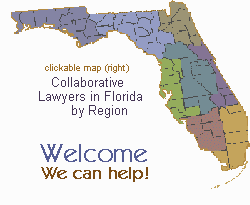
include attorneys serving throughout all regions of Florida, including: South
Florida ( Southeast
Florida, Miami-Dade, Palm Beach, and Broward County and cities: Fort Lauderdale, Pompano Beach, Boca Raton, etc.), Southwest
Florida, Central
Florida, East
Central Florida, West
Central Florida, North
Central Florida, Northwest
Florida, and Northeast
Florida. Contact us for more information about collaborative family law.
This website is sponsored by the Palm Beach, Florida divorce law firm of Lisa Marie Macci, P.A.,
and by The Law Offices of
Elizabeth J. Kates, Esq., Broward County family law and estate planning. Macci
& Kates is an association of
independent law firms who work with each other in consulting, co-counsel or of counsel
relationships in selected trial-level matters and appellate cases,
in order to better serve the needs of mutual clients.
We do appeals from family courts in all counties and circuits, and for all Florida appellate courts:
Broward, Miami-Dade. Palm Beach, Escambia, Okaloosa, Santa Rosa, Walton, Franklin, Gadsden, Jefferson,
Leon, Liberty, Wakulla, Columbia, Dixie, Hamilton, Lafayette, Madison, Suwannee, Taylor, Clay, Duval,
Nassau, Citrus, Hernando, Lake, Marion, Sumter, Pasco, Pinellas, Flagler, Putnam, St. Johns, Volusia, Alachua,
Baker, Bradford, Gilchrist, Levy, Union, Orange, Osceola. Hardee, Highlands, Polk, DeSoto, Manatee, Sarasota,
Hillsborough, Bay, Calhoun, Gulf, Holmes, Jackson, Washington, Monroe, Brevard, Seminole, Indian River, Martin,
Okeechobee, St. Lucie, Charlotte, Collier, Glades, Hendry, Lee.

|
|